Shotoku Ichibuban Die Study
Few types of Japanese bar money are rare enough for a die study to possibly encompass all dies in existence, but for a few types, I believe this is quite possible. Shotoku ichibuban are one of the last types that are both sufficiently rare and have enough variation in dies for such a study to be a reasonably simple undertaking.
Given the severe lack of references that identify how to differentiate Shotoku ichibuban from Keicho ichibuban (see here), a more thorough analysis of the dies has confirmed the separation of these types.
Full Die Map
Each line on the die map below represents one example and each blue circle is a unique die. All Shotoku ichibuban that I've been able to find photos of are represented on this map as of April 2026 (27 examples).
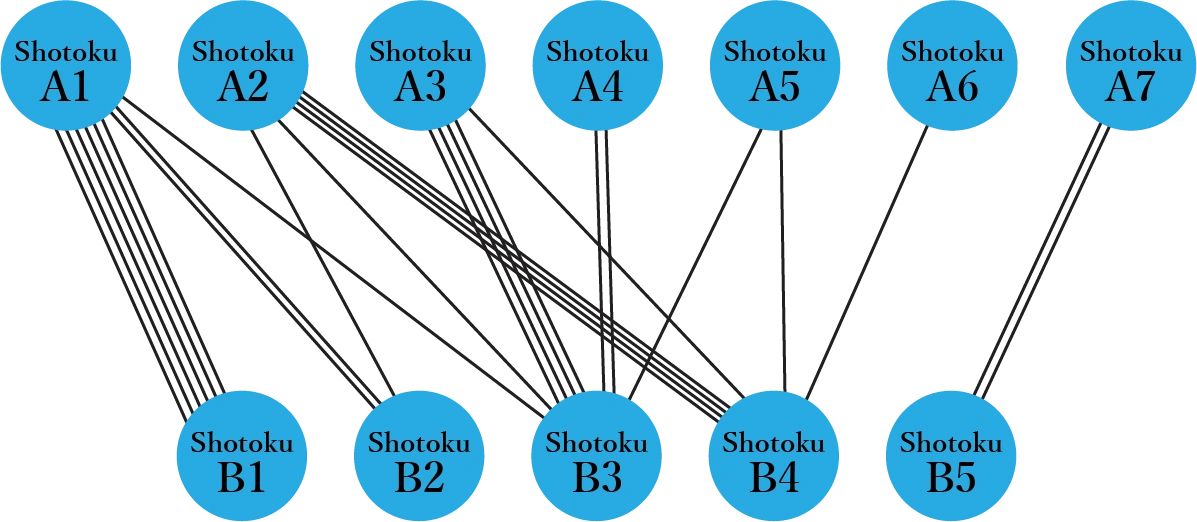
In all 27 coins, I've seen only one die that isn't found on multiple pieces - Shotoku-A6. Every other die is found on at least two coins. This implies to me that this sample represents most, if not all, possible dies.
Die Links
With the exception of Shotoku-A7 and Shotoku-B5, every other die is ultimately linked together, confirming that they were part of the same mintage. None of these dies were in use during another era and mistakenly grouped with Shotoku ichibuban by collectors based on shared characteristics: they all belong together.
In the Keicho die study, I didn't find any group of dies that resulted in similar maps. The complex linkages tell us that these were minted together, and the frequent repetition of dies confirms that this group had a low original mintage.
However, we do have to address the two dies that are not linked to the others. Why are they separate? And more importantly, are they actually Shotoku ichibuban?
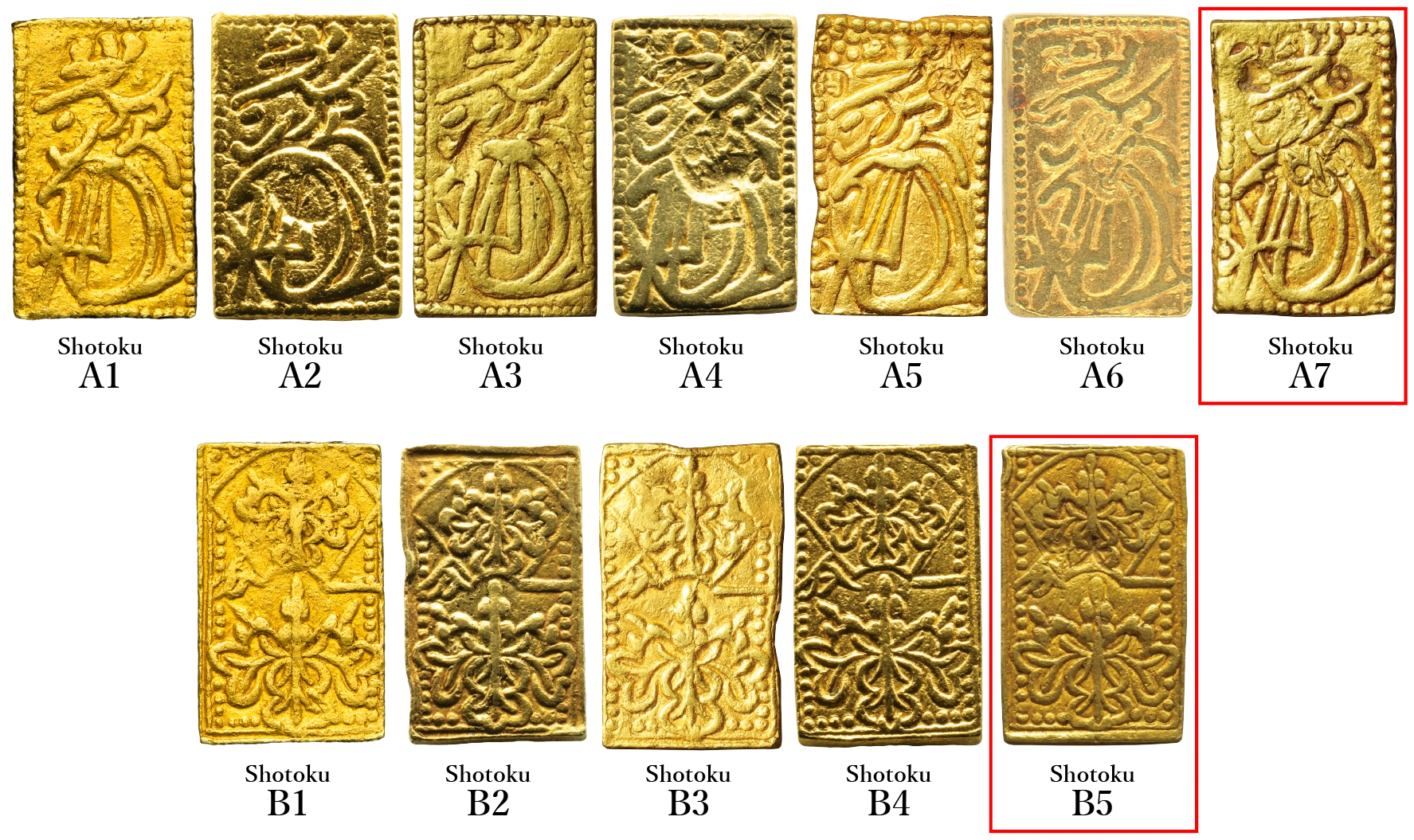
Update: Hours before the most recent site update was scheduled to go live, I was made aware of a piece pairing A7 with B1, confirming that these dies are part of the genuine Shotoku mintage. This will be added to the die map and the text updated accordingly on the next site update. The rest of this section was written before this piece was discovered.
Starting with side A, there are calligraphy distinctions that this die only shares with other Shotoku ichibuban. If you look at the consistences depicted under the A dies, all three features are present on Shotoku-A7 and cannot be found together on any Keicho or Kyoho ichibuban. Combined with the general strike clarity of both examples, I don't believe these could be any genuine coins other than a Shotoku ichibuban.
If we look at side B, we find that this die, Shotoku-B5, is incredibly similar to Shotoku-B2. In fact, these two dies are the most difficult to tell apart from the entire group.
I believe it's most likely that these two coins are genuine Shotoku ichibuban and that pieces will eventually be found that link the dies to the rest of the group, or perhaps specific circumstances in the mint resulted in them only being paired with each other, in which case we'll likely never know for sure.
Alternatively, it's possible that these are incredibly well done contemporary counterfeits that were produced using Shotoku-B2 as a reference for the B die. The chopmarks and overall circulation wear on both known examples is consistent with the group as a whole, so I don't believe they are modern counterfeits.
Overall, I would not be hesitant to purchase an example using these dies.
Minting Process Implications Compared to Gaku Ichibuban
The most noteworthy feature of this die map when compared to the map for Gaku ichibuban, which includes a similar number of dies, is how interconnected the Shotoku dies are. This suggests that the minting process had changed since the time of the Gaku ichibuban. While the Gaku die map suggests that only one person was minting coins at any given moment and only one pair of dies was in service at a time, the Shotoku map suggests that most of the dies were in use simultaneously. It seems they may have been paired randomly on different days by different workers, as opposed to waiting for a die to fail to replace it with a new one.
Finding More Examples
While I believe the current study includes the vast majority of pieces that have been imaged online, I invite photos of any other examples. Specifically, if you've purchased a piece in a private sale or acquired it prior to 2010, it's likely missing from the study and I'd love to see photos. Populations won't be updated here very often, but I will add any new dies or significant die pairings as they appear or are shared with me.
All photos used in this die study are shared for educational purposes only. No coins or photographs are owned by the author. Photos come from PCGS, Ginza Coin, Taisei Auctions, Nihon Auctions, Auction-World, Stack's Bowers Galleries, and Japan Antique Coin.